Poison ivy changes form, size, and color depending on where it grows and what time of year it is. These four attributes stay consistent regardless. When in doubt, text us a photo and we'll tell you for free.
Leaf size ranges from half an inch to six inches, but the arrangement never changes: the leaves always come in threes. Almond-shaped, often glossy on top. The center leaflet has a longer stem than the two on either side, and the two side leaflets usually have a thumb-like bump on their outer edge, almost like a mitten. This one rule holds across every form, every season, every environment. When in doubt, don't touch it.
Poison ivy adapts well to its environment. It can creep along the ground as a vine, climb trees thirty feet or more, or grow as a dense shrub-like clump. A young plant on the ground looks nothing like a mature vine on an oak trunk. The form changes. The hazard does not.
Scarlet and shiny in early spring, then it loses the shine and turns a matte green through summer. Yellow, orange, red, and scarlet again in fall. Bare and leafless in winter, but still toxic. Urushiol isn't just in the leaves; it's in every part of the plant, including the vine and roots, and it can cause a reaction year-round, even after the leaves have dropped.
Urushiol clings to tools, gloves, shoes, clothing, and pet fur long after contact. It stays active for months. Every surface the plant touched is a risk until properly cleaned. Burning is the most dangerous form of exposure. Inhaled urushiol affects the lungs directly.
The leaves can be lime green, shiny green, dull green, yellow, orange, red and scarlet.
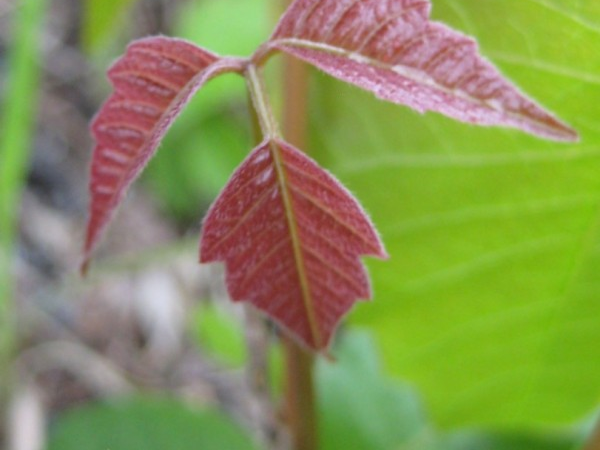
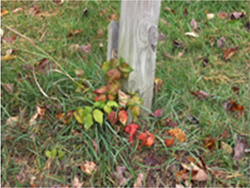
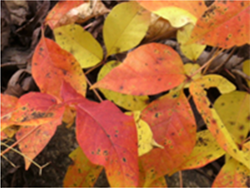
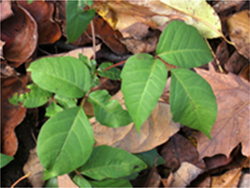
⚠ All parts of the plant (leaves, stems, roots, berries, and bare winter vines) contain urushiol. Burning is the most dangerous form of exposure.
Not everyone is. Some people have no reaction at all. Others range from mildly sensitive to severely allergic. Sensitivity can increase with repeated exposure over time.
Every member of our crew is allergic. The founder is severely allergic. The people drawn to this kind of work often are. It is our experience, preparation, and processes that allow us to do the work we do safely, season after season.
If you think you have been exposed, wash the area with soap and cold water immediately. Cold water closes the pores and slows absorption of the oil.
"It is our experience, preparation, and processes that allow us to do the work we do."
Helaine, Founder
First response
Wash with soap and cold water as soon as possible. Avoid hot water. Hot water opens pores and speeds absorption of the oil.
These are things our team has tried over many years of working with the plant. Not everything works for everyone, but these three come up consistently.
There are only two remedies that really work for me. One is to go to the beach and soak in the salt water. My mother and I had really bad cases of poison ivy once and we did not itch while we were at the beach. I filled four gallon jugs of seawater and brought them home to continue the treatment. It did not work. It just was not the same. Being completely immersed in seawater was the only way to stop the itching.
The other remedy was a homeopathic salve made from jewelweed. I slathered it onto my rash and the itching stopped, but it smelled so bad that I decided I would rather itch and washed it off.
External resources we point people to when they want to go further on identification, distribution, or treatment.
A comprehensive reference on identification, rash treatment, and plant distribution across North America.
The most effective over-the-counter wash we have found for poison ivy rash. Provides hours of relief and significantly shortens recovery time.
Home of Poison Ivy Identification Week, an annual effort to sharpen public recognition of the plant.
Cloth test squares that turn magenta on contact with urushiol. Useful for checking tools, shoes, and gear after working near the plant.
Go to SeeLeaf.com and buy these cloth squares that turn magenta when they come in contact with the oil from poison ivy that causes the rash.
These cloths are also the way to find out what IS poison ivy and what is NOT poison ivy. This is the way to solve the problem. Use these wipes on your gardening tools, shoes, and dog and figure out where the urushiol oil is located. Just put on a disposable glove and wipe the cloth on the leaves you suspect are poison ivy. If it turns magenta, it's poison ivy. If the cloth stays white, it's NOT poison ivy. Simple.
As a Poison Ivy Removal Specialist, Zanfel Poison Ivy Wash is a must. I use it on my rash and I get 6 to 8 blessed hours of no itching. It allows me to sleep all night. Zanfel removes the poison ivy plant's oil from the skin and starts the healing.
Kelly, nine years on the job, also swears by it. She says it takes the 2 to 3 week rash down to 2 to 3 days. I hand out a tube of Zanfel to every new crew member. We could not work around poison ivy without it. Invaluable.